26 Jun 2020

JEE Syllabus 2020 (Main & Advanced) :- Examen

JEE Syllabus 2020 (Main & Advanced)


JEE Main Syllabus 2020 - National Testing Agency has released the official JEE Main 2020 syllabus including the sample questions for the newly added Planning section in Paper 2. Candidates can access the syllabus of JEE Main 2020 from the article below in PDF to know important topics and plan their studies accordingly. Candidates preparing for JEE Main can go through the subject wise important concepts and topics through the JEE Main syllabus 2020. With the help of JEE Main 2020 syllabus, students can study and focus on topics that will require more time and concepts which can be mastered easily. Along with the syllabus of JEE Main, students can also check out the exam pattern and previous year question papers to get an idea about the difficulty level of exam, nature of questions asked and a lot more. Read the complete article to get detailed information about JEE Main syllabus 2020.

The JEE 2020 syllabus can be split into two major categories – the JEE Main 2020 syllabus and the JEE Advanced 2020 syllabus. Several topics fall under the syllabus for both of these examinations. However, certain topics are unique to the JEE main syllabus and some select topics are unique to the JEE Advanced 2020 syllabus.
Therefore, it is advisable for candidates to familiarize themselves with the key differences in the syllabi of JEE Main 2020 & JEE Advanced 2020. Access JEE Syllabus 2020 for Main & Advanced by following the links tabulated below.

JEE Main 2020 Paper 1 Syllabus (PCM)

Subject-wise list of all the chapters covered in the syllabus of JEE Main 2020 is provided here. The topic-wise weightage of IIT JEE is highly uncertain, therefore, the students are advised to prepare the entire syllabus without skipping. JEE Main syllabus is mapped as per class 11 and class 12 NCERT textbooks to ensure uniformity across the country. Have a complete overview of the entire syllabus and accordingly formulate a suitable preparation strategy.
Syllabus of JEE Main

JEE Main Physics Syllabus

Physics and MeasurementThermodynamics
KinematicsRotational Motion
GravitationWork and Energy
PowerProperties of Solids and Liquids
Laws of MotionElectronic Devices
OscillationsWaves
Current ElectricityElectromagnetic Waves
Communication SystemsElectromagnetic Induction
MagnetismAlternating Currents
Magnetic Effects of CurrentKinetic Theory of Gases
Dual Nature of MatterRadiation
AtomsNuclei
OpticsElectrostatics

Physics is an interesting subject for most of the JEE aspirants. A good score from this section requires meticulous planning. Concepts like electricity, mechanics, and magnetism constitute around 65% of marks distribution. All these concepts are of utmost importance.

JEE Main Chemistry Syllabus

Physical Chemistry
Basic concepts in ChemistryStates of Matter
Chemical bondingAtomic Structure
SolutionsSolutions
Redox ReactionsChemical Thermodynamics
EquilibriumElectrochemistry
Surface ChemistryChemical Kinetics
Organic Chemistry
PolymersPrinciples of Practical Chemistry
Organic Compounds – Characterisation and PurificationOxygen, Halogens, and Nitrogen Organic Compounds
HydrocarbonsBiomolecules
Basics of Organic ChemistryChemistry in everyday life
Inorganic Chemistry
HydrogenClassification of Elements
PeriodicityAlkali metals
Group 13 to Group 18 ElementsAlkaline earth metals
D and f block elementsCoordination compounds
Environmental chemistryIsolation of metals

All three sections of chemistry are interlinked. Candidates can start with Physical Chemistry section before moving on to the other two parts. Practice solving different type of questions like matching type, multiple-choice, and assertion reason type questions to boost one’s reasoning skills.

JEE Main Maths Syllabus

Sets, Relations, and FunctionsComplex Numbers
DeterminantQuadratic Equations
MatricesPermutations Combinations
Mathematical InductionSequence Series
Binomial TheoremLimits and Continuity
DifferentiabilityStatistics
Differential EquationsIntegral Calculus
TrigonometryVector Algebra
Coordinate GeometryMathematical Reasoning
3D GeometryProbability

Topics covered in Maths are a perfect blend of simple and complex topics. Maths is easy to score if students develop a good understanding of the basic concepts. Concentrate on concept building and enhancing numerical solving skills by practising often.

JEE Main 2020 Paper 1 Exam Pattern

Exam Mode: Computer-Based (Online)
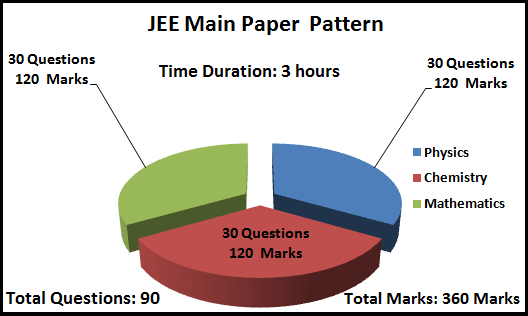
Exam Duration: 3 Hours
Subjects: Physics, Chemistry, and Mathematics
Total Number of Questions: 75 (25 Physics + 25 Chemistry + 25 Maths)
Question Types: 20 MCQs & 5 Numerical Questions for Each Subject (PCM)
Maximum Marks: 300
Marking Scheme: 

  • MCQ: Correct Answer = +4, Incorrect Answer = -1, Unattempted Answer = 0
  • Numerical Question: Correct Answer = +4, Incorrect & Unattempted Answer = 0
Exam Languages: English, Hindi, and Gujarati

Important Physics Topics for JEE Main 2020 (with Marks-Wise Weightage)

(Please note that these topics have been listed from the trends observed over the last 5 years. Also, please note that each question carries 4 marks)

Electrostatics – 1 Question (3.3% Weightage)
Current Electricity – 3 Questions (9.9% Weightage)
Capacitors –  1 Question (3.3% Weightage)
Magnetic Effect of Current and Magnetism – 2 Questions (6.6% Weightage)
Alternating Current – 2 Questions (6.6% Weightage)
Kinetic Theory of Gases & Thermodynamics – 2 Questions (6.6% Weightage)
Simple Harmonic Motion – 1 Question (3.3% Weightage)
Sound Waves – 1 Question (3.3% Weightage)
Kinematics – 2 Questions (6.6% Weightage)
Work, Energy, and Power – 2 Questions (6.6% Weightage)
Laws of Motion – 2 Questions (6.6% Weightage)
Centre Of Mass – 2 Questions (6.6% Weightage)
Rotational Dynamics – 2 Questions (6.6% Weightage)
Modern Physics – 2 Questions (6.6% Weightage)
Elasticity – 1 Question (3.3% Weightage)
Wave Optics – 2 Questions (6.6% Weightage)
Error in Measurement – 1 Question (3.3% Weightage)
Circular Motion – 1 Question (3.3% Weightage)
Electromagnetic Waves – 1 Question (3.3% Weightage)
Semiconductors – 1 Question (3.3% Weightage)
Communication Systems – 1 Question (3.3% Weightage)

Important Chemistry Topics for JEE Main 2020 (with Marks-Wise Weightage)

Transition Elements & Coordination Compounds – 3 Questions (9.9% Weightage)
Periodic table, s and p-Block Elements – 3 Questions (9.9% Weightage)
Thermodynamics & the Gaseous State – 2 Questions (6.6% Weightage)
Atomic Structure – 2 Questions (6.6% Weightage)
Chemical Bonding – 2 Questions (6.6% Weightage)
Chemical And Ionic Equilibrium – 2 Questions (6.6% Weightage)
Solid-State And Surface Chemistry – 2 Questions (6.6% Weightage)
Nuclear & Environmental Chemistry – 2 Questions (6.6% Weightage)
Mole Concept – 1 Question (3.3% Weightage)
Redox Reactions – 1 Question (3.3% Weightage)
Electrochemistry – 1 Question (3.3% Weightage)
Chemical Kinetics – 1 Question (3.3% Weightage)
Solution & Colligative Properties – 1 Question (3.3% Weightage)
General Organic Chemistry – 1 Question (3.3% Weightage)
Stereochemistry – 1 Question (3.3% Weightage)
Hydrocarbon – 1 Question (3.3% Weightage)
Alkyl Halides – 1 Question (3.3% Weightage)
Carboxylic Acids & their Derivatives – 1 Question (3.3% Weightage)
Carbohydrates, Amino-Acids, and Polymers – 1 Question (3.3% Weightage)
Aromatic Compounds – 1 Question (3.3% Weightage)

Important Maths Topics for JEE Main 2020 (with Marks-Wise Weightage)

Quadratic Equations – 1 Question (3.3% Weightage)
Sequences & Series – 2 Questions (6.6% Weightage)
Trigonometric Equations – 1 Question (3.3% Weightage)
Limits – 1 Question (3.3% Weightage)
Differentiability – 1 Question (3.3% Weightage)
Indefinite Integration – 1 Question (3.3% Weightage)
Definite Integration – 1 Question (3.3% Weightage)
Differential Equations – 1 Question (3.3% Weightage)
The Area under the Curve – 1 Question (3.3% Weightage)
Straight Lines – 2 Questions (6.6% Weightage)
Vectors – 1 Question (3.3% Weightage)
3-D Geometry – 2 Questions (6.6% Weightage)
Permutations & Combinations – 1 Question (3.3% Weightage)
Probability – 1 Question (3.3% Weightage)
Complex Numbers – 1 Question (3.3% Weightage)
Binominal Theorem – 1 Question (3.3% Weightage)
Determinants – 2 Questions (6.6% Weightage)
Tangents and Normals – 1 Question (3.3% Weightage)
Maxima and Minima – 1 Question (3.3% Weightage)
Statistics – 1 Question (3.3% Weightage)
Parabola – 1 Question (3.3% Weightage)
Ellipse – 1 Question (3.3% Weightage)
Hyperbola – 1 Question (3.3% Weightage)
Mathematical Reasoning – 1 Question (3.3% Weightage)
Height & Distance – 1 Question (3.3% Weightage)
Sets – 1 Question (3.3% Weightage)

JEE Main Paper 2 & 3 Syllabus (Aptitude Test B. Arch/ B.Planning)

Part IAwareness of persons, places, Buildings, Materials. Objects, Texture related to Architecture and build—environment. Visualising three-dimensional objects from two-dimensional drawings. Visualising. different sides of three-dimensional objects. Analytical Reasoning Mental Ability (Visual, Numerical and Verbal).
Part IIThree dimensional – perception: Understanding and appreciation of scale and proportion of objects, building forms and elements, colour texture, harmony and contrast. Design and drawing of geometrical or abstract shapes and patterns in pencil. Transformation of forms both 2 D and 3 D union, subtraction, rotation, development of surfaces and volumes, Generation of Plan, elevations and 3 D views of objects. Creating two dimensional and three-dimensional compositions using given shapes and forms.

Sketching of scenes and activities from memory of urbanscape (public space, market, festivals, street scenes, monuments, recreational spaces, ect.), landscape (river fronts, jungles, trees, plants, etc.) and rural life.

JEE Main 2020 Paper 2 & 3 Exam Pattern

Exam Mode: Computer-Based (Online)
Exam Duration: 3 Hours
Subjects: Mathematics, General Aptitude, & Drawing (B.Arch.) or Planning (B.Plan.)
Total Number of Questions: 

B.Arch.: 77 (25 Maths + 50 Aptitude + 2 Drawing )

B.Plan.: 100 (25 Maths + 50 Aptitude + 25 Planning)

Question Types:

  • 20 MCQs & 5 Numerical Questions for Maths
  • 50 MCQs for Aptitude
  • 25 MCQs for Planning (B.Plan. only)
  • 2 Drawing Questions for Drawing (B.Arch. only).
Maximum Marks: 400
Marking Scheme: 

  • MCQ: Correct Answer = +4, Incorrect Answer = -1, Unattempted Answer = 0
  • Drawing Section = 2 Questions for a Total of 100 Marks
Exam Languages: English, Hindi, and Gujarati

SSC JE Syllabus 2020 - Latest Syllabus & SSC JE Exam Pattern For All Engineering Branches (Civil,Mechanical & Electrical)

SSC JE Syllabus 2020 - Latest Syllabus, Booklist & SSC JE Exam Pattern For All Engineering Branches

SSC JE Syllabus 2020

SSC JE Syllabus 2020: To ace SSC JE Exam, candidates must be well versed with SSC JE Syllabus. As the syllabus is really vast, it is necessary for every candidate to be acquainted with every single topic been asked in the SSC JE Exam.

The SSC Junior Engineering (SSC JE) exam has two papers – Paper 1 and Paper 2. The Paper-I of SSC JE 2020 exam will be conducted from 1st Sept to 4th Sept 2020. Candidates appearing for SSC JE exam should be aware of SSC JE syllabus 2020 along with all topics. In this article, we are covering detailed SSC JE Syllabus and Exam Pattern for all engineering branches (Civil,Mechanical & Electrical)

SSC JE Syllabus

The standard of the questions in Engineering subjects will be approximately of the level of Diploma in Engineering (Civil/Electrical/Mechanical) from a recognized Institute, Board or University recognized by All India Board of Technical Education. 


SSC JE Exam Pattern

SSC JE Examination will consist of two Papers i.e. Paper-I and Paper-II. The Paper-I will be conducted online (Computer Based Examination). Paper-II Exam is a Descriptive Type Paper which be held offline (Written Examination). You need to check the exam pattern before going through the syllabus of SSC JE.

SSC JE Paper-I Exam Pattern

SubjectNumber of QuestionsMaximum MarksDuration & Timings
General Awareness50502 Hours
General Intelligence and Reasoning5050
Part A- General Engineering (civil & structural) or
Part B- General Engineering (electrical) or
Part C- General Engineering (mechanical) or
100100

Note: There will be negative marking of 0.25 marks for each wrong answer in Paper-I.

SSC JE Syllabus for Paper-I

SSC JE 2020 Paper 1 is conducted in the online mode and has three sections which are mentioned below:
(i). General Intelligence and Reasoning
(ii). General Awareness
(iii). General Engineering

(i) SSC JE Syllabus for General Intelligence & Reasoning

SSC covers both verbal and non-verbal type questions in General Intelligence & Reasoning section. The test will be based on on analogies, similarities, differences, space visualization, problem solving, analysis, judgement, decision making, visual memory, discrimination, observation, relationship concepts, arithmetical reasoning, verbal and figure classification, arithmetical number series etc topics. The test will also include questions designed to test the candidate’s abilities to deal with abstract ideas and symbols and their relationships, arithmetical computations and other analytical functions.

(ii) SSC JE Syllabus for General Awareness

Questions asked in this section will be aimed at testing the candidate’s general awareness of the environment around him/her and its application to society. Questions will also be designed to test knowledge of current events and of such matters of everyday observations and experience in their scientific aspect as may be expected of any educated person. The test will also include questions relating to India and its neighbouring countries especially pertaining to History, Culture, Geography, Economic Scene, General Polity and Scientific Research, etc. These questions will be such that they do not require a special study of any discipline.

(iii) SSC JE Syllabus for General Engineering (Civil and Structural), (Electrical & Mechanical):

Part-A : Civil Engineering

Building Materials, Estimating, Costing and Valuation, Surveying, Soil Mechanics, Hydraulics, Irrigation Engineering, Transportation Engineering, Environmental Engineering.

Structural Engineering:

Theory of Structures, Concrete Technology, RCC Design, Steel Design.

Part-B : Electrical Engineering

Basic concepts, Circuit law, Magnetic Circuit, AC Fundamentals, Measurement and Measuring instruments, Electrical Machines, Fractional Kilowatt Motors and single phase induction Motors, Synchronous Machines, Generation, Transmission and Distribution, Estimation and Costing, Utilization and Electrical Energy, Basic Electronics.

Part-C : Mechanical Engineering

Theory of Machines and Machine Design, Engineering Mechanics and Strength of Materials, Properties of Pure Substances, 1st Law of Thermodynamics, 2nd Law of Thermodynamics, Air standard Cycles for IC Engines, IC Engine Performance, IC Engines Combustion, IC Engine Cooling & Lubrication, Rankine cycle of System, Boilers, Classification, Specification, Fitting & Accessories, Air Compressors & their cycles, Refrigeration cycles, Principle of Refrigeration Plant, Nozzles & Steam Turbines. Properties & Classification of Fluids, Fluid Statics, Measurement of Fluid Pressure, Fluid kinematics, Dynamics of Ideal fluids, Measurement of Flow rate, basic principles, Hydraulic Turbines, Centrifugal Pumps, Classification of steels.

Click SSC-JE 2020 paper 1 syllabus (PDF)

SSC JE Syllabus for Paper II

SSC JE Paper-II Exam Pattern

SubjectMaximum MarksDuration & Timings
General Engineering(Civil & Structural)3002 Hours
Part B- General Engineering (Electrical)
Part C- General Engineering (Mechanical)


GATE 2021 SYLLABUS, EXAM PATTERN & PREPARATION STRATEGY :- Examen

About GATE

The Graduate Aptitude Test in Engineering (GATE) is an All-India examination administered and conducted in eight zones across the country by the GATE Committee comprising of Faculty members from IISc, Bangalore and other seven IIT’s on behalf of the National Coordinating Board, Department of Education, Ministry of Human Resources Development. The GATE score/rank is used for admissions to Post Graduate Programmes (ME, M.Tech, MS, direct PhD) in institutes like IIT and IIScetc with financial assistance offered by MHRD. PSUs too use the GATE scores for recruiting candidates for various prestigious jobs with attractive remuneration.

In GATE examination, candidates can apply for only one of the 24 papers listed in the table given below. Candidates are expected to appear in a paper appropriate to the discipline of their qualifying degree. However, candidates are free to choose any paper according to their admission plan, keeping in mind the eligibility criteria of the institutions in which they wish to seek admission. For more details regarding the admission criteria in any particular institute, candidates are advised to refer to the websites of that particular institute.

PAPER

CODE

PAPER

CODE

Aerospace Engineering

AE

Geology and Geophysics

GG

Agricultural Engineering

AG

Instrumentation Engineering

IN

Architecture and Planning

AR

Life Sciences

XL

Biotechnology

BT

Mathematics

MA

Civil Engineering

CE

Mechanical Engineering

ME

Chemical Engineering

CH

Mining Engineering

MN

Computer Science &

Information Technology

CS

Metallurgical Engineering

MT

Chemistry

CY

Physics

PH

Electronics and Communication

Engineering

EC

Production and Industrial Engineering

PI

Electrical Engineering

EE

Textile Engineering &Fibre Science

TF

Engineering Sciences

XE

Ecology and Evolution

EY

Petrolium Engineering

PE

Statistics

ST

GATE 2021 Syllabus Check Stream-wise Syllabus
(ME, CSE, IN, CE, EE, and ECE)

GATE is a highly competitive exam where lakhs of engineering students appear for the examination to qualify and secure admissions in M.Tech and Postgraduate programs.

IIT Bombay will be the organizing institute for the GATE 2021.

IIT Bombay will officially release the GATE 2021 syllabus along with brochure for the GATE 2021 exam.

GATE Syllabus for any engineering stream is a very exhaustive one, as it will cover around 10-14 subjects from the engineering streams. It requires a thorough understanding of GATE Syllabus for a effective preparation strategy.

Hence, all the engineering students before appearing for GATE 2021 exam should analyze the GATE syllabus and the GATE exam pattern before starting their GATE preparation.

GATE 2021 syllabus will help the candidates to know the important subjects and topics. All the questions in GATE exam will be based on the GATE syllabus defined and hence all GATE exam aspirants should be thorough with GATE syllabus and complete every topic thoroughly.GATE Eligibility

The eligibility to appear for GATE exam is as follows:

  •  Bachelor's degree holders in Engineering/Technology/ Architecture (4 years after 10+2) and those who are in the final year of such programmes.
  •  Bachelor's degree holders in Engineering/Technology/Architecture (Post-B.Sc./Post-Diploma) and those who are in the final year of such programmes.
  •  Master's degree holders in any branch of Science/Mathematics/ Statistics/Computer Applications or equivalent and those who are in the final year of such programmes.
  •  Candidates in the second or higher year of the Four-year Integrated Master's degree programme (Post-B.Sc.) in Engineering/Technology.
  •  Candidates in the fourth or higher year of Five-year Integrated Master's degree programme or Dual Degree programme in Engineering/Technology.
  •  Candidates with qualifications obtained through examinations conducted by professional societies recognized by UPSC/AICTE (e.g. AMIE by Institute of Engineers (India); AMICE by Institute of Civil Engineers (India) as equivalent to B.E./B.Tech. Those who have completed section A or equivalent of such professional courses are also eligible.

GATE Exam Pattern

Section

Question

No

No. of

Questions